The Dirty Truth About Utility Climate Pledges
Utilities are trying to greenwash their dirty plans.
It’s time to hold them accountable.
Share the Report
The next decade is critical to averting the worst impacts of the climate crisis and transforming our economy to run entirely on clean energy.
Studies show that unless utilities retire all their coal plants by 2030, abandon all plans to build gas plants, and aggressively build out renewable energy resources, we risk destabilizing our livable climate. Despite this pressing deadline, utilities are either not moving fast enough toward these goals, or not moving at all.
Dozens of utilities may have pledged to become “carbon neutral” by 2050, but research conducted by the Sierra Club in the Dirty Truth Report shows that nearly all utilities in the United States lack the plans needed to make those plans a reality by moving toward clean energy in the time frame needed to avoid the worst of the climate crisis.
What utilities do, or don’t do, between now and 2030 will either seal our fate or deliver us from future climate catastrophe. What is your utility doing?
Is Your Utility Part of the Problem?
Find out using the search bar below.
_ gets _
KEY FINDINGS
The Dirty Truth About Utility Climate Pledges 2023 Report

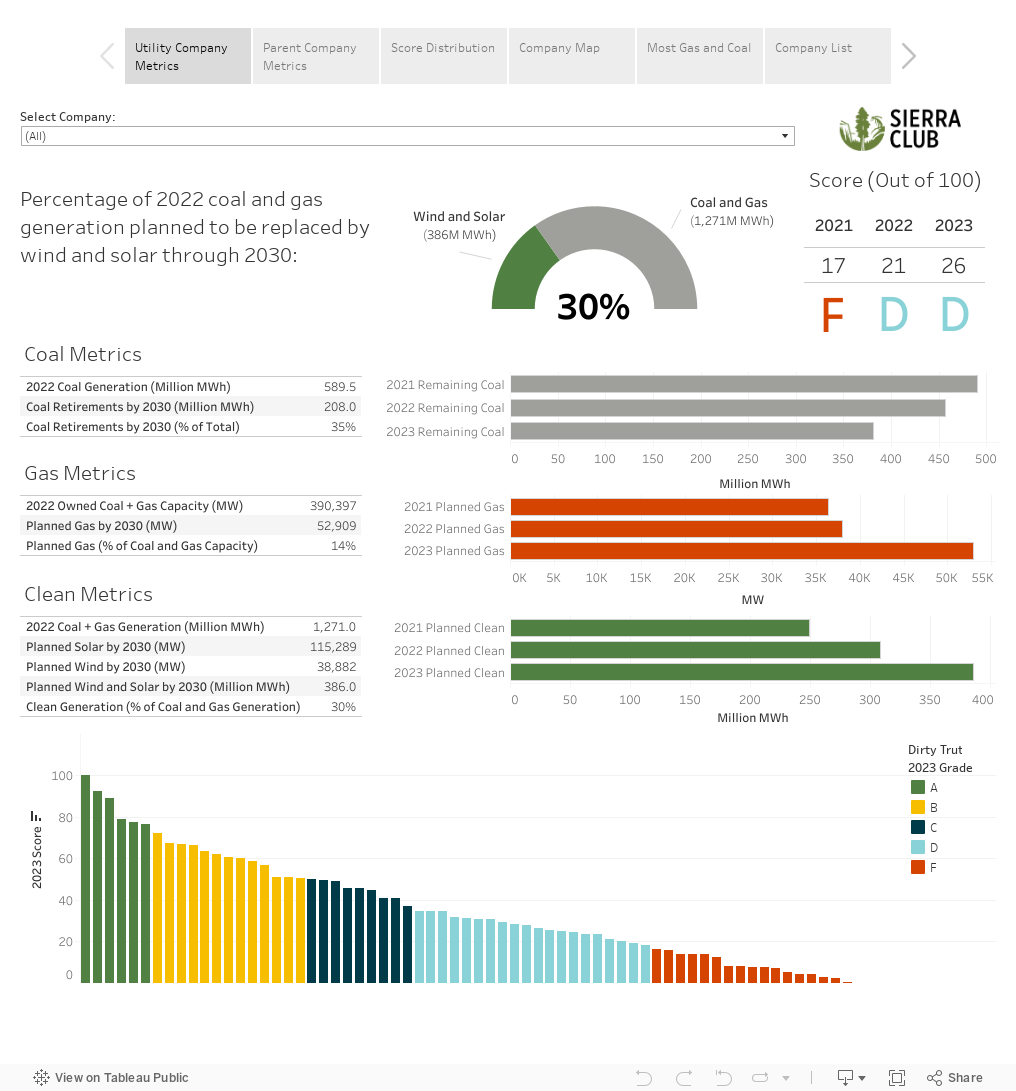
The utilities studied scored 26/100 in the Sierra Club’s Dirty Truth Report, earning a D. These utilities have only improved their overall score by 9 points since 2021.
BY 2030, THE 50 UTILITIES MOST INVESTED IN FOSSIL FUEL GENERATION ARE...

Only committed to retiring
35% of their coal.

Only building enough clean energy to replace
30% of their fossil fuels.

Planning to build
53 gigawatts of new gas,
even more than last year.

Only 10 of these utilities are committed to reducing their emissions by 80% by 2030, which science tells us is necessary to limit heating to 1.5° C.
 These 10 utilities with the strongest climate goals receive a combined score of 48, far outperforming the rest.
 Utilities without any climate goal at all score far worse, receiving a 0.

Together, we achieved the largest investment in our climate and clean energy in US history through the Inflation Reduction Act (IRA), putting hundreds of billions of dollars toward programs to spur the clean energy transition. This law should be a catalyst that accelerates plans for a clean energy transition from utilities that have previously lagged, saving customers money and reducing climate pollution.
The Sierra Club’s The Dirty Truth About Utility Climate Pledges report is a comprehensive assessment of whether utilities are committing to the actions needed to avert a cataclysmic climate crisis. The report is based on an analysis of long-term energy plans - known as integrated resource plans (IRPs) - and major announcements from the 50 utilities that generate the most electricity from coal and gas. This includes investor-owned utilities, public utilities (like the Tennessee Valley Authority), generation and transmission co-ops, and large municipal utilities.
In total, Sierra Club analysts examined plans for 77 operating companies owned by 50 parent companies that own half of all remaining coal and gas generation in the US. The report shows that almost all of their pledges to become “carbon neutral” sometime in the future are nothing more than distractions from the fact that they are not transitioning from fossil fuels to clean energy fast enough.
The Case for Clean Energy
Every year a coal plant stays online is another year the neighboring community - which in the U.S. is frequently Black, Indigenous, people of color, or low income - suffers from elevated rates of asthma, heart disease, and other health problems. As of 2023, the remaining coal plants without plans to retire by 2030 are responsible for about 3,800 premature deaths per year due to particulate pollution. In addition, renewables such as wind and solar, especially when combined with storage and smart energy management, can increase resiliency and reduce the risk of blackouts and other energy shortages due to extreme weather, which are more likely to occur in Black and Latinx communities.
Utilities can become partners in the transition to a clean energy economy and a better, more sustainable future. By making real commitments to eliminate climate pollution - commitments that are backed up by near-term, concrete, binding plans - utilities can lead the way to a future with a stable climate, economic opportunities, and clean air for all.
What Is Your Utility Company Doing to Transition to Clean Energy?
Use the tool below to learn more about your utility company’s pledge and how they’re doing.
For the best experience, use a desktop computer. If you prefer, you can view in Tableau.
Join the Movement for Clean Energy and a Livable Planet
The Sierra Club is fighting every day for a cleaner, healthier planet for all. Sign up to join us.
Share to Show Your Support of Clean Energy
Taking action for clean energy by 2030 will be critical in keeping the climate crisis from spinning out of control, and we need your help in getting your utility on board with ditching fossil fuels and investing in clean energy. Share with your networks and spread the word to hold utilities accountable. Make sure to tag your utility and use the hashtag #DirtyTruth.

Learn More
The Sierra Club's energy work is moving the world beyond fossil fuels. See our Beyond Coal campaign page for more information.